When Love Enters the Counselling Room
Why talk about love in counselling?
The word love often sits uneasily in counselling. Clients long for it, fear it, or have been wounded by its misuses.
Therapists sometimes hesitate to name it at all, worried that the word itself could blur boundaries or carry implications of romance. Yet love remains at the heart of what it means to be human. It shapes attachment, belonging, safety, and trust. If counselling is a relationship that aims at healing, then questions about love cannot be avoided.
Love is never far away from conversations about shame and honour. Shame emerges when our need for connection is threatened, whilst honour reflects the dignity of being received, respected and known in relationship. To talk about love is therefore to talk about the fragile yet powerful dynamics of care, recognition, and human worth.
The difficulty is that English uses one blunt word for a wide range of experiences. Other languages and cultures offer more nuanced vocabularies. Exploring these different expressions of love not only enriches our understanding of the human condition but also offers counsellors in the UK a deeper well of language, imagination, and practice.
The complexity of the word love in English
English speakers reach for the same word whether they mean romance, friendship, parental devotion, spiritual longing, or loyalty to a football team. It is no wonder confusion arises in therapy when a client says “I love you” or when a counsellor wants to communicate deep regard. The word is overburdened.
C. S. Lewis offered a helpful start by distinguishing between eros (romantic passion), philia (friendship), storge (affection within family), and agape (selfless or divine love). These categories are not perfect but they do show that English once knew more nuance than is often recognised. Counselling requires this same attentiveness. A therapist who offers unconditional positive regard is not offering eros. A client who longs to be seen with warmth is not asking for a romantic bond.
The limitations of English vocabulary can sometimes obscure these distinctions. One word carries many different meanings, leaving therapists to listen carefully for what clients are really describing.
How other cultures shape love through language
Greek:eros,philia,storge and agape
Greek remains the most familiar starting point because it distinguishes between different kinds of love rather than assuming one word can carry them all.
Eros speaks of romantic and passionate desire. In the therapy room, this is the form of love that most clearly requires thoughtful boundaries, particularly when clients experience transference or confusion about the therapeutic relationship.
Philia describes the love found in friendship, built on mutual respect, trust and shared humanity. Clients who struggle with loneliness, belonging or social isolation are often grieving not only the absence of companionship, but the absence of philia.
Storge refers to the affection that develops within families. For some clients, it offers a language for security, belonging and being accepted simply because they exist. For others, it highlights painful experiences of obligation, emotional neglect or relationships in which love felt conditional. When storge is absent, shame often takes root in its place, leaving people believing they must earn the care they were never freely given.
Perhaps the most relevant for counselling is agape, often described as unconditional or self-giving love. It is not sentimental, romantic or possessive. Instead, it is a steady commitment to another person's dignity and wellbeing without expecting anything in return. Whilst therapy is not an expression of agape in its pure theological sense, many clients experience something that echoes it: being met with consistent care, respect and acceptance within the safety of clear professional boundaries.
Japanese: amae
The Japanese concept of amae has no direct equivalent in English. It describes the comfort of leaning on another person with the expectation that they will respond with kindness rather than rejection. It is the trust of a child resting against a parent, or the quiet confidence that a close relationship can tolerate dependency without withdrawing.
In counselling, amae offers another way of understanding behaviours that can easily be misunderstood. A client who repeatedly asks for reassurance, apologises for taking up space, or worries that they are "too much" may not be seeking attention or testing the therapist. They may be asking a much quieter question.
"If I let you see what I really need, will you still be here?"
When we understand amae, behaviour that once looked "needy" can begin to look very different. Often, it is not dependency at all. It is the courage to discover whether another person can remain present when our need is finally seen.
Korean: jeong
Unlike passionate love, jeong grows slowly. It develops through shared experiences, consistency and the countless ordinary moments that accumulate over time. It is less about what is said than what is repeatedly demonstrated.
This offers a helpful reminder that healing relationships are rarely built through dramatic interventions. They are built through reliability. A counsellor remembering something a client mentioned weeks earlier, greeting them warmly, holding the thread of previous conversations, or remaining emotionally present through difficult sessions may all communicate a therapeutic form of jeong.
These moments are easy to overlook because they appear so ordinary. Yet they quietly tell the client, "I remember you."
Portuguese: saudade
Saudade expresses love through absence. It is the quiet ache of longing for someone or something that has been lost, whilst recognising that what is gone continues to shape who we are. It captures a bittersweet mixture of grief, gratitude and enduring connection.
Clients experiencing bereavement, separation, migration or significant life transitions often live in saudade. Rather than encouraging them to "move on", therapy can become a place where that longing is honoured. Love does not disappear because someone is absent. Sometimes it becomes most visible in the space they leave behind.
What these words reveal is that love is far richer than English often allows us to express. Some forms of love grow slowly. Some emerge through compassion. Others are rooted in longing, friendship or family. Each offers counsellors another way of understanding the relationships their clients describe. Perhaps the question is not whether love belongs in therapy, but whether our vocabulary is broad enough to recognise the many ways it already appears.
Shame, honour, and the moral weight of love
Across cultures, love is not only an emotion but a moral act. To express love can affirm status or threaten it. Shame arises when love is withheld, or when affection risks exposing vulnerability. Honour arises when love is expressed in ways that protect dignity.
In therapy, these dynamics are alive. A client may feel shame if they perceive their longing for care as weakness. They may fear dishonour if they admit love for a parent who also harmed them. Counsellors must hold this tension with care. When we honour clients, we communicate that their needs do not diminish their worth. When we name shame, we open a path for it to signal the deeper need for connection rather than becoming a source of isolation.
Therapeutic traditions and love-adjacent language
Carl Rogers rarely used the language of love. Instead he wrote about unconditional positive regard, empathy and congruence. Yet many clients experience these conditions as forms of love that feel safe precisely because they ask for nothing in return. They allow therapists to express care without stepping outside professional boundaries. Later writers on relational depth describe the profound meeting of client and counsellor where the client feels fully accepted.
Other therapeutic traditions also speak of love indirectly. Attachment-informed therapy highlights secure base and safe haven functions, which are expressions of steadfast care. Compassion-focused therapy explicitly invites both therapist and client to cultivate compassionate mind states. Even psychodynamic approaches, with their caution around transference, recognise that the longing for love shapes the therapeutic relationship.
Risks and misunderstandings in the counselling room
The word love is not neutral. For some clients, it recalls romance and sexuality. For others, it carries memories of manipulation or abuse. Therapists who use the word unthinkingly risk boundary violations or retraumatisation. Yet avoiding the word entirely can also create distance. Some clients may feel unseen if their expressions of love are minimised.
Navigating this requires discernment. Counsellors need to listen for the meanings their clients attach to love. They need to be clear about boundaries, able to distinguish between the love they offer in therapeutic regard and the forms of love that belong in other relationships.
Cultural translation: learning to listen for a client’s language of love
Every client brings a cultural lexicon. Some will resonate with words of affection. Others will prefer gestures of continuity, reliability, or respectful silence. Counsellors should ask clients what words or expressions feel comfortable. They should notice when a client lights up at recognition, or when shame signals that a word has landed badly.
This is not about adopting exotic terms uncritically. It is about humility. By listening for the client’s way of naming love, counsellors honour their culture and protect their dignity.
Reflections for Practice
If love has many languages, then our work as counsellors is not to decide which expression is correct, but to become curious about the one our client is speaking.
That curiosity has practical implications. We might listen more carefully for the meaning a client attaches to the word love, rather than assuming we already understand it. We might become more attentive to the ways shame silences expressions of care, or notice when a client's culture communicates love more readily through consistency than through words.
It also reminds us that professional boundaries are not the opposite of love. They are one of the ways therapeutic love remains safe. Clear endings, reliable timekeeping, confidentiality and emotional consistency all communicate respect for the relationship and the dignity of the person within it.
Finally, this perspective invites us to reflect on our own language. When we speak of empathy, unconditional positive regard, compassion or relational depth, are we describing different facets of what many clients experience as love? If so, perhaps our task is not to avoid the subject, but to develop a richer and more ethically grounded vocabulary for talking about it.
- When a client says "I love you", what kind of love are they trying to name?
- Which language of love feels most natural in your own therapeutic practice, and which do you find more difficult to receive or express?
- How might your client's culture shape the way they recognise care, safety and belonging?
Finally: Towards an Honourable Language of Love in Counselling
The question is not whether love belongs in counselling, but how it can be expressed ethically, safely and with integrity. English alone cannot capture the richness of human experience, yet by learning from other cultures we expand more than our vocabulary. We deepen our capacity to recognise the many ways people seek connection, communicate care and experience belonging. By paying attention to shame and honour, we become more attuned to the ways love can both wound and heal.
Perhaps that is why love matters so much in counselling. Not because therapists are there to rescue, fix or become part of a client's life, but because every human being needs at least one relationship in which they can be fully seen without losing their dignity. When that happens, healing often follows.
Perhaps love, expressed with wisdom, humility and clear professional boundaries, is not another therapeutic technique at all. Perhaps it is the quiet foundation upon which every effective therapeutic relationship is built.
Reflective Companion
Reflective Companion
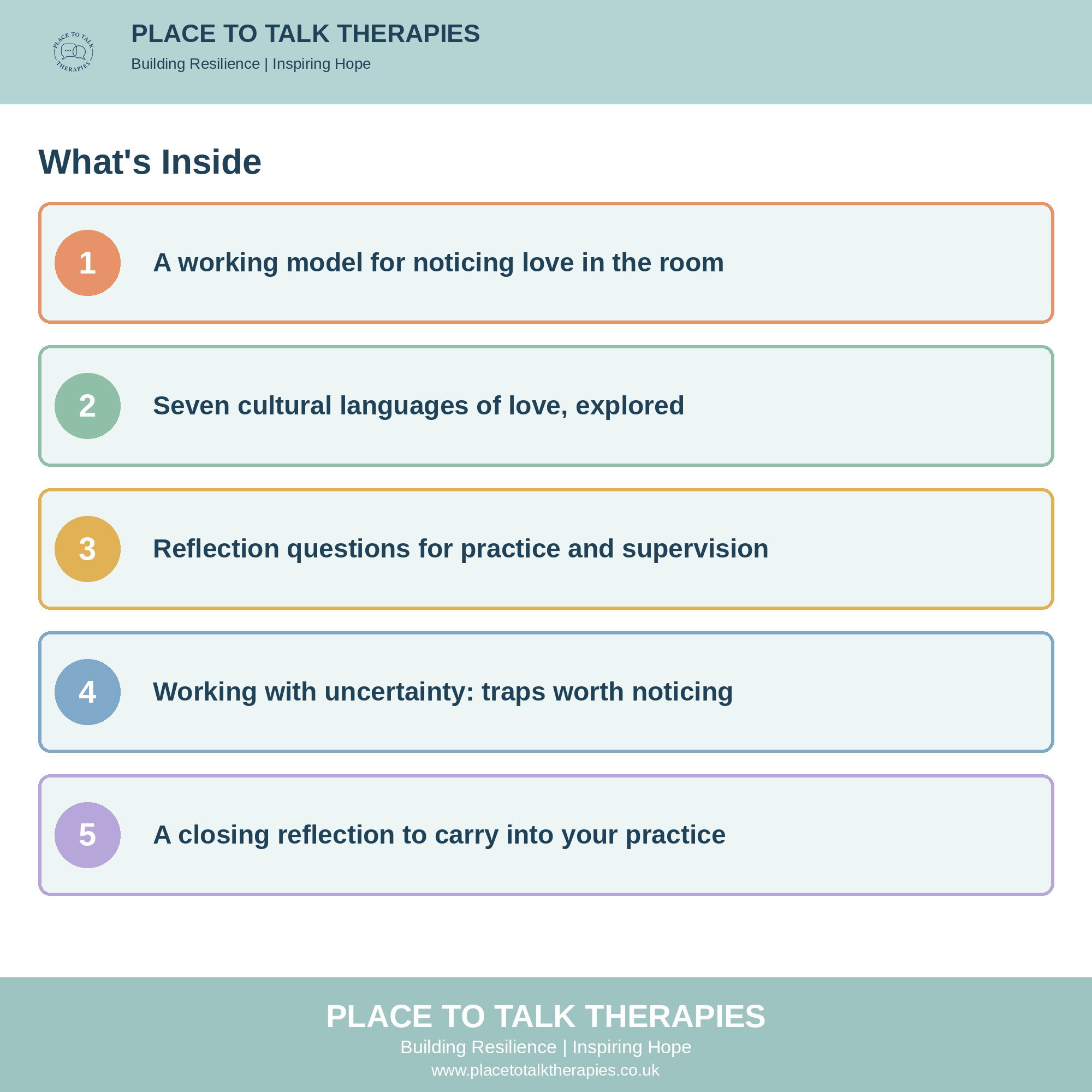
If these ideas have prompted you to pause and reflect, Exploring the Languages of Love in Therapy is a printable companion designed for counsellors, psychotherapists and clinical supervisors. It includes reflective prompts, supervision questions and practical frameworks to help you explore how different expressions of love, shame and honour may already be present within your therapeutic work.
Which language of love do you naturally offer in the therapy room? More importantly, which language of love is your client hoping someone will finally understand?
The companion can be used for individual reflection, within clinical supervision or as part of your continuing professional development.
Exploring the Languages of Love in Therapy
Written by: Kay Parkinson
Place to Talk Therapies
Building resilience | Inspiring hope
Kay is a UK-based therapist specialising in shame- and trauma-informed, neurodivergent-affirming practice. She is passionate about fostering empathy, authenticity, and understanding in therapeutic and professional relationships. Through her writing, Kay encourages reflective, compassionate approaches that honour the complexity and resilience of the human experience.