Resilience: Building Strength from Within
Introduction
In our fast-paced and often unpredictable world, the concept of resilience has gained significant attention. Many mistakenly believe that resilience means never falling, never experiencing pain, or always bouncing back immediately from adversity. However, true resilience is far more nuanced and profound. It is not about avoiding life's inevitable challenges, but rather about the dynamic process of adapting, growing, and moving forward with our experiences.
At Place to Talk Therapies, our mission is to empower individuals by building resilience and inspiring hope, recognising that this capacity is a fundamental aspect of emotional wellbeing. This blog post will delve into the true nature of resilience, exploring its psychological underpinnings, key components, and practical strategies that can be cultivated through awareness, consistent practice, and professional support.
Understanding Resilience: More Than Just "Bouncing Back"
For decades, psychological research has evolved its understanding of resilience. Initially, it was often viewed as an innate trait, something individuals either possessed or lacked. However, contemporary psychology has largely shifted to understanding resilience as a dynamic process, a set of learned behaviours and coping mechanisms that enable individuals to navigate stress and adversity effectively. This shift is crucial because it implies that resilience is not a fixed characteristic but a skill that can be developed and strengthened over time, regardless of one's starting point.
It is also important to distinguish between resilience and thriving. While resilience focuses on adapting to challenges and returning to a baseline of functioning, thriving suggests an ability to not only recover but to grow and flourish beyond the initial state, often leading to enhanced personal development and a deeper appreciation for life. Both concepts are intertwined, with resilience often serving as a prerequisite for thriving.
The biological and psychological foundations of resilience are complex. Our brains possess remarkable neuroplasticity, the ability to reorganise themselves by forming new neural connections throughout life. This capacity allows us to adapt to new experiences and learn new coping strategies, which is fundamental to building resilience. Furthermore, our stress response system, while essential for survival, can be modulated through resilient practices, preventing chronic stress from overwhelming our mental and physical health.
Understanding these mechanisms helps us appreciate that resilience is not merely a mental construct but is deeply rooted in our biological makeup.
The Pillars of Resilience
Building resilience involves cultivating several key psychological and behavioural components. These pillars act as foundational strengths that enable individuals to navigate life's adversities more effectively:
- Emotional Regulation - is the ability to manage and respond to an emotional experience. It involves understanding one's emotions, accepting them, and developing healthy strategies to cope with intense feelings. Resilient individuals are not immune to strong emotions; instead, they possess the skills to acknowledge these feelings without being overwhelmed by them, allowing for a more measured and adaptive response to challenging situations.
- Cognitive Flexibility - refers to the ability to adapt one's thinking to new, changing, or unexpected situations. It involves shifting perspectives, challenging negative thought patterns, and engaging in positive reappraisal, finding the silver lining or learning opportunity in difficult circumstances. This allows individuals to view setbacks not as insurmountable obstacles but as temporary challenges that can be overcome or learned from.
- Social Connection - humans are inherently social beings, and strong social connections are a cornerstone of resilience. A robust support network, comprising family, friends, mentors, or support groups, provides emotional comfort, practical assistance, and a sense of belonging during times of stress. Knowing that one is not alone and having individuals to confide in significantly buffers the impact of adversity and promotes recovery.
- Self-Compassion - involves treating oneself with kindness, understanding, and acceptance, especially during moments of perceived failure or suffering. It is the antithesis of harsh self-criticism and allows individuals to acknowledge their pain without judgement, recognising that imperfection is part of the human experience. Cultivating self-compassion fosters emotional strength and reduces the likelihood of shame and self-blame, which can be debilitating during challenging times.
- Meaning-Making - the process of finding purpose, understanding, or personal growth from difficult or traumatic experiences. It involves re-evaluating one's values, priorities, and life narrative in the aftermath of adversity. This pillar allows individuals to transform suffering into a source of wisdom and strength, fostering a sense of coherence and hope for the future.
Practical Strategies to Build Resilience
Resilience is not a static trait but a dynamic capacity that can be intentionally cultivated through consistent practice.
Here are several evidence-based strategies that individuals can integrate into their daily lives:
- Mindfulness and Grounding - involves paying attention to the present moment without judgement. Practices such as meditation, mindful breathing, and body scans can enhance emotional regulation and reduce reactivity to stress. Grounding techniques, which involve focusing on sensory details in the immediate environment, can help individuals stay present and prevent emotional overwhelm during moments of distress.
- Cognitive Reframing - a powerful technique that involves identifying and challenging negative or unhelpful thought patterns and replacing them with more balanced and realistic ones. Instead of viewing a setback as a personal failure, for example, one might reframe it as a learning opportunity or a temporary obstacle. This shift in perspective can significantly alter emotional responses and promote a more adaptive outlook.
- Building a Support System - Actively nurturing and expanding one's social network is vital for resilience. This involves reaching out to trusted friends, family members, or support groups, and engaging in activities that foster a sense of community and belonging. Sharing experiences, receiving empathy, and offering support to others can create a powerful buffer against isolation and stress, reinforcing the idea that one does not have to face challenges alone.
- Setting Realistic Goals - Breaking down large, daunting goals into smaller, achievable steps can significantly boost self-efficacy and resilience. Each small success builds confidence and provides a sense of progress, even during challenging times. Celebrating these small victories reinforces a positive feedback loop, motivating individuals to continue striving towards their larger objectives.
- Physical Wellbeing - The connection between physical and mental health is undeniable. Prioritising physical wellbeing through adequate sleep, nutritious eating, and regular physical activity profoundly impacts resilience. Sleep deprivation, poor nutrition, and a sedentary lifestyle can exacerbate stress and diminish coping resources. Conversely, a healthy body supports a resilient mind, enhancing mood, cognitive function, and emotional stability.
Resilience in Therapy: How Professional Support Helps
While self-help strategies matter, working with a therapist can accelerate and deepen this process in ways that are harder to reach alone. At Place to Talk Therapies, we draw on strengths-based, evidence-informed approaches to help you notice and build on what's already working, alongside developing new ways of coping. Therapy offers a safe, confidential space to explore past experiences, current pressures and future worries, without judgement.
Conclusion
Remember, building resilience is a journey, not a destination, and every step forward, no matter how small, contributes to a more robust and hopeful future.
If you are seeking support on this journey, Place to Talk Therapies is here to help you build your inner strength and inspire lasting hope.
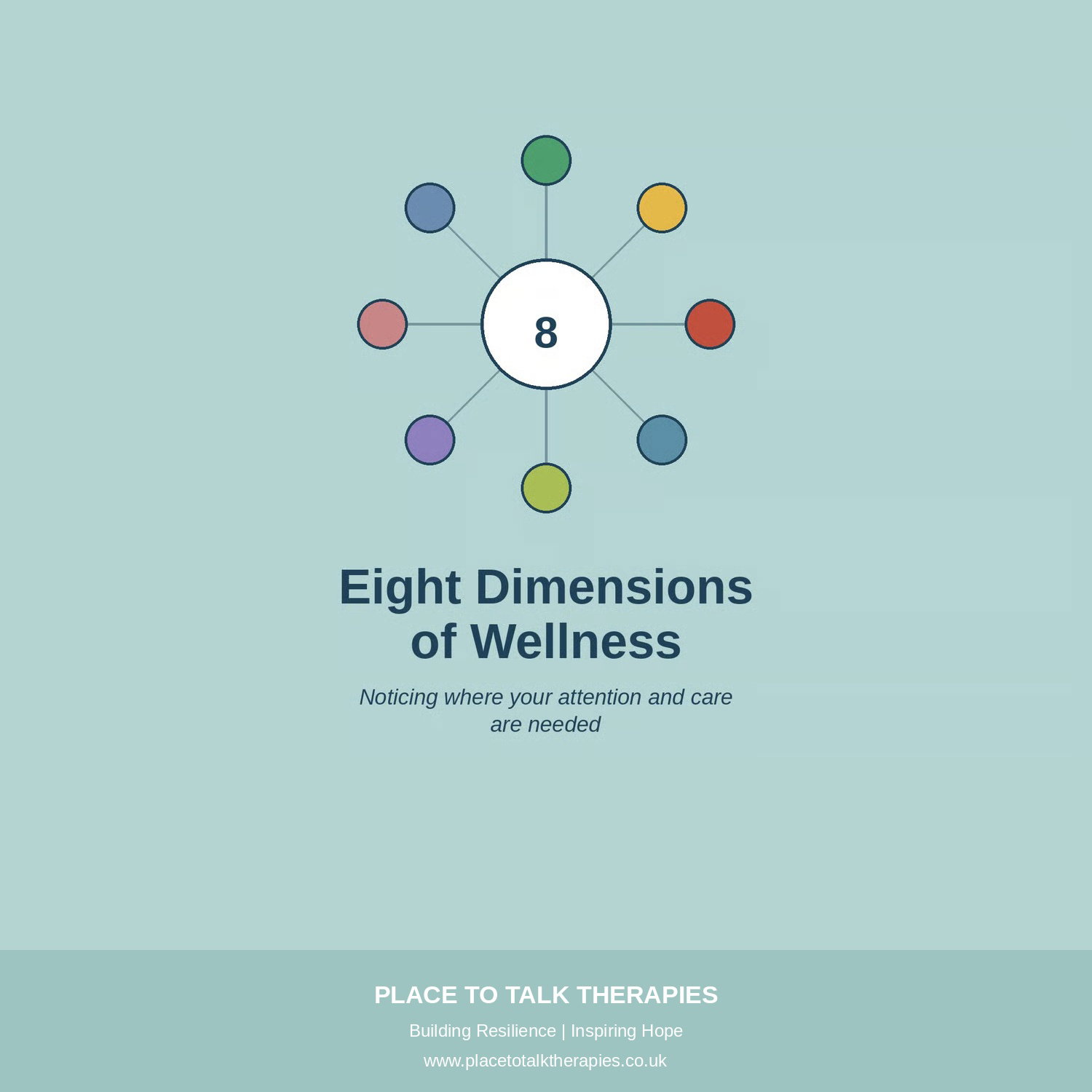
If you'd like a broader way to check in with different areas of your life, the Eight Dimensions of Wellness offers a simple tool for exactly that.
👉 Eight Dimensions of Wellness: £1
Written by: Kay Parkinson
Place to Talk Therapies
Building resilience | Inspiring hope
Kay is a UK-based therapist specialising in shame- and trauma-informed, neurodivergent-affirming practice. She is passionate about fostering empathy, authenticity, and understanding in therapeutic and professional relationships. Through her writing, Kay encourages reflective, compassionate approaches that honour the complexity and resilience of the human experience.
References
Psychological resilience: an update on definitions, a critical review
Resilience Theory: Core Concepts & Research Insights
The Psychology of Resilience — Ontario Psychological Association
The 8 Key Elements of Resilience — Psychology Today
Enhance Resilience: Evidence-Based Strategies for Well-Being
The role of social support networks in mental health recovery and resilience
19 Resilience Activities & Training to Overcome Adversity
Resilience to Stress and Adversity: A Narrative Review — PMC
The Role of Resilience in Mental Health Recovery
Resilience and Quality of Life in People with Mental Illness
Five Science-Backed Strategies to Build Resilience
How To Be More Resilient: 8 Strategies for Difficult Times
Psychological Resilience — an overview, ScienceDirect Topics
24 Evidence-Based Ways to Train and Track Resilience
Resilience — American Psychological Association
Strengths-based cognitive–behavioural therapy: a four-step model to build resilience