How to Choose a Counsellor
What Actually Matters
Most people searching for a counsellor have never had to do it before.
You may know that something isn't quite right. Perhaps you've been struggling for a while, or something has happened that has left you feeling as though you don't quite know what to do next. Maybe someone has suggested counselling, or perhaps you've finally reached the point where you think, I can't keep doing this on my own.You start looking, and that's where it can get surprisingly difficult.
There are counsellors everywhere, with different qualifications, approaches, specialisms, fees and ways of working. Everyone has a website telling you a little about themselves, and after a while they can all start to blur into one.

How do you actually choose the right counsellor for you?
I've found this difficult too
I'm a counsellor, so you might assume choosing a counsellor would be relatively straightforward for me. It isn't.
I've had my own experience of looking for the right person, and I found myself doing exactly what many people do. Reading profiles, looking at qualifications, thinking about different approaches and wondering whether I would actually feel comfortable talking to this particular person.
There was also the slightly uncomfortable realisation that knowing what makes a good counsellor on paper doesn't necessarily make it any easier to choose one for yourself. When you're the person looking for help, you're not simply comparing qualifications. You're wondering, Could I actually talk to this person? Would I feel understood? Would I be able to say the things I don't usually say?
It took me time to find the right counsellor for me. When I did, I noticed something I hadn't been able to work out from a website or a list of qualifications. I felt able to be myself. Not the version of myself that had everything worked out, and not the counsellor who knew all the right terminology. Just me.
There was trust, there was challenge when I needed it, and there was room for things that were difficult to say. I didn't feel I had to perform or somehow get counselling "right".
That experience has stayed with me. It reminds me that finding the right counsellor isn't necessarily about finding the most qualified person, or even the person who looks best on paper. It's about finding someone with whom you can do the work, and sometimes you don't know what that feels like until you experience it.
Why choosing a counsellor isn't like choosing a plumber
There are, of course, things you can check quite easily.
Training, qualifications, professional registration, experience, location, availability and cost all matter.If you're looking for a counsellor or psychotherapist in the UK, it's worth checking their training and whether they are registered or accredited with a professional body. You may come across BACP, UKCP, BABCP or ACC.
If you're thinking, that's a lot of letters, you're not wrong.The world of counselling has rather a fondness for acronyms. BACP is the British Association for Counselling and Psychotherapy, UKCP is the UK Council for Psychotherapy, BABCP is the British Association for Behavioural and Cognitive Psychotherapies, and ACC is the Association of Christians in Counselling and Linked Professions.
Each organisation has its own requirements for membership, registration and accreditation, so it is worth looking at what a particular status means rather than assuming they are all the same. Accreditation can involve additional requirements around training, knowledge, experience and professional development, depending on the organisation and the particular accreditation.
These professional standards can give you some reassurance and useful information about the person you're considering, and help you understand what their particular status means. They are a good place to start. They just aren't the whole picture.
Unfortunately, there isn't an acronym for "Will I actually feel comfortable telling this person what is really going on?" There should be.
Choosing a counsellor is more like choosing shoes rather than choosing a plumber. You can check the size, the material and the price, yet none of that tells you how they'll actually feel once you've worn them for a while. With a plumber, you probably don't need to wonder whether you feel comfortable enough to tell them something you've never told anyone before. With a counsellor, you do, and that's a different kind of fit to look for.
Look at their experience, not just their qualifications
A counsellor can have excellent qualifications and still not be the right person for you. That doesn't mean they're a bad counsellor. It just means people relate differently to different people.
Experience matters too. If you're looking for help with trauma, you may want to know whether the counsellor has specific trauma training and experience. If you're grieving, you may want someone familiar with bereavement. If ADHD or autism is part of your experience, you may want someone who understands neurodivergence.
You don't need someone who has lived exactly what you've lived. You can, however, ask whether they have experience working with something similar and whether they understand the particular difficulties you are bringing.
It can also be helpful to think about whether their way of working makes sense to you. You don't need to understand every therapeutic model before you begin, and you shouldn't have to become an expert in counselling in order to choose a counsellor. A good therapist should be able to explain their approach in ordinary language and help you understand how it might be relevant to you.
Why the relationship matters more than the CV
This is the part you can't really work out from a website.
Research has consistently found an association between the therapeutic alliance, the connection and working relationship between therapist and client, and therapy outcomes. A substantial 2018 research study looked at 295 independent studies involving more than 30,000 people, and found a consistent positive relationship between the therapeutic alliance and treatment outcomes across different therapeutic approaches, client characteristics and countries.
That doesn't mean you need to instantly like your counsellor, or that every session should feel comfortable.
Some of the most useful conversations might be uncomfortable. You may hear yourself saying something you've been avoiding for years. You may disagree with your counsellor, or leave a session with more questions than answers.
What matters is whether there is enough trust for you to be honest. Enough room to say, "I'm not sure about that," or "I don't agree." Enough freedom that you don't have to spend the whole session trying to be the person you think your counsellor wants you to be. The relationship itself becomes part of the work.
The First Conversation Matters More than the Website
Most counsellors offer a short introductory call before any commitment is made. This exists for a reason. It is the point where a website profile turns into an actual person, with a voice, a pace, a way of listening.

Perhaps you've had the experience of speaking to someone new and feeling your shoulders drop slightly within the first few minutes. Maybe you've also had the opposite experience, of a conversation that was perfectly pleasant and left you feeling strangely unseen. Both of those reactions are information, and both are worth taking seriously.
It can help to notice practical things too, such as whether this person answers questions directly rather than deflecting them, and whether they explain their way of working in plain language rather than jargon. Perhaps most tellingly, notice whether they leave space for you to ask something that feels difficult to ask.
Notice your own reactions too. Maybe you feel relieved. Maybe you feel uncomfortable. Maybe you immediately think, no, definitely not.
That reaction is worth noticing, although it isn't necessarily something to blindly follow. If you've spent years second-guessing yourself, keeping other people happy or assuming your needs are too much, your first reaction may need curiosity rather than compliance.
Sometimes we need to ask ourselves a slightly different question. Rather than simply asking, "Do I like this person?", you might ask, "What am I noticing about myself when I'm with this person?" That can be a much more useful question.
Don't confuse familiarity with fit
We can feel comfortable with people because they feel familiar, but familiar isn't necessarily the same as healthy.
If you're used to keeping everyone happy, a counsellor who encourages you to say what you really think might initially feel uncomfortable. If you've learned to keep your emotions under control, being encouraged to notice them might feel strange. If you've spent years minimising your own needs, having someone take them seriously can feel surprisingly unfamiliar. That discomfort often isn't a sign that something is wrong with you. It's a sign that something is finally being asked of you that nobody asked before.
Don't assume that feeling comfortable automatically means you've found the right counsellor. Equally, don't assume that feeling uncomfortable means you've chosen the wrong one. Counselling can be both comfortable and uncomfortable.
What matters is whether there is enough trust, respect and openness for you to explore what is happening.
What should you ask a counsellor?
You don't need to arrive with a list of interview questions, but there are some things it is perfectly reasonable to want to know.
You might ask about their training and professional registration, their experience with what you're bringing, how they normally work and whether they think their approach might be suitable for you. You may want to know how often sessions take place, how much they cost, whether they offer face-to-face or online counselling and what happens if you need to cancel or rearrange a session. You can also ask whether they offer an initial conversation, and what happens if, after a few sessions, you decide that you don't think they're the right counsellor for you.
It is your counselling, and you are allowed to find out whether the arrangement works for you.
What if you get it wrong?
This is something people sometimes worry about. What if you choose someone and it doesn't work? What if, after a few sessions, something just doesn't feel right?
You haven't failed. Sometimes you only discover what you need by discovering what you don't need. You might find that you don't feel heard, that you don't feel able to disagree, or that the counsellor's way of working simply doesn't make sense to you, or that there isn't the connection you were hoping for. You can talk about that.
A good counsellor should be able to hear that something isn't working for you. Sometimes the relationship itself can become part of the work, particularly if you're able to talk openly about what you're experiencing. You don't have to leave because one session was difficult, and you don't have to stay simply because someone has impressive qualifications.
You don't have to know exactly what you need
Perhaps the most important thing to remember is that you don't need to arrive at your first counselling session with a diagnosis, a perfectly formed explanation or even a clear idea of what kind of therapy you need.
You can simply say, "Something isn't right, and I don't really know what I need." That's enough to start with.
All therapists have different training, experience and ways of working, because no one approach or one person suits everyone. If you're unsure who might be the best fit, you can get in touch and have a conversation. You don't have to have it all worked out before you take the first step.
Choosing a counsellor is a choice
There isn't a perfect counsellor who will be right for everyone.
Qualifications matter. Experience matters. Professional standards matter, and so does the person sitting opposite you.
Ultimately, you're not just choosing someone who knows about counselling. You're choosing someone you're going to talk to about parts of your life that may be difficult to talk about anywhere else.
There is simply the question of whether this particular person, with their particular experience and way of working, feels like someone you could work with.
Trusting What You Notice
There is no single right counsellor for everyone. There can, however, be a poor fit, whether through mismatched competence, unclear boundaries, a lack of relevant specialist experience, or simply a therapeutic relationship that never quite settles, however much goodwill is on both sides.
Recognising that possibility is not pessimism. It is part of what makes the decision worth taking seriously. Fit is not the same as ease. Good therapy will sometimes be uncomfortable, because it asks a person to look at things they have avoided for good reason. What matters is whether the discomfort feels held by someone trustworthy, rather than simply added to a pile that already feels too heavy.
Choosing a counsellor is one of the few decisions where the most useful evidence is not on the page at all. It is in the small, difficult-to-name sense of whether a person feels safe enough to be honest with, and curious enough to be helpful. That sense is worth noticing, though not always worth trusting without question, particularly for anyone whose early experience taught them that familiarity and safety are not always the same thing.Notice the profile that made you pause.
Notice what happens in you when you hear their voice.Give yourself permission to take those reactions seriously, without asking them to make the whole decision for you.
The right fit does not remove the difficulty of the work ahead. It simply means you will not be doing it alone.
Want this to hand, whenever you need it?
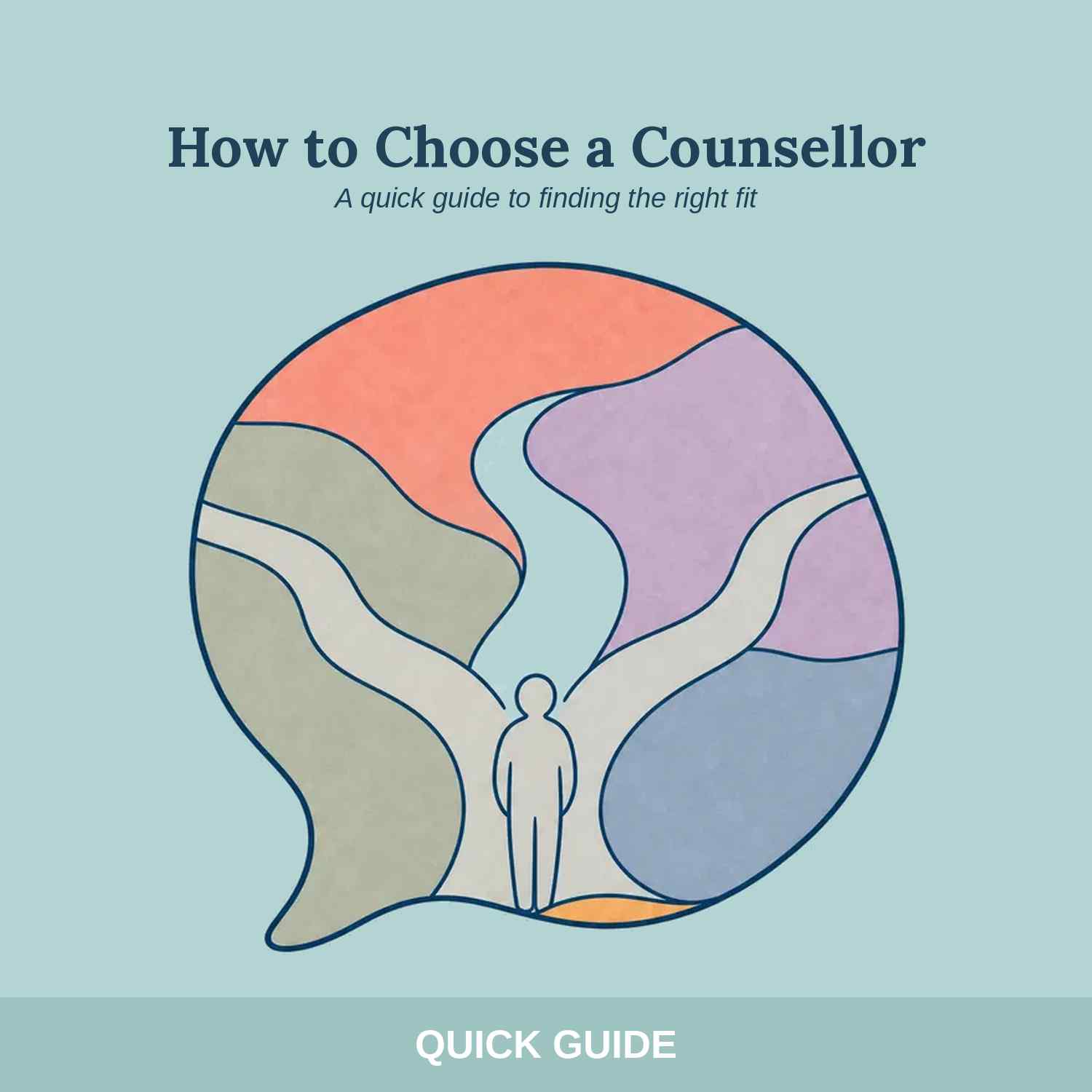
This short one-page guide brings together what to check, what to ask, and what to notice in yourself when you're choosing a counsellor.
Written by Kay Parkinson, MBACP (Accred) psychotherapist. Place to Talk Therapies offers individual counselling in person and online across the UK.
www.placetotalktherapies.co.uk
Further reading
Flückiger, C., Del Re, A. C., Wampold, B. E. & Horvath, A. O. (2018). The Alliance in Adult Psychotherapy: A Meta-Analytic Synthesis. Psychotherapy, 55(4), 316–340. DOI: 10.1037/pst0000172.