When the World Turns the Volume Up
Why this time of year can feel like too much, and why that makes more sense than you might think.
The first fireworks went off weeks ago, on an ordinary weeknight, and you felt them in your chest before you properly heard them. Since then the supermarket has started playing the same handful of songs on a loop. The lights in the town centre went up while it still felt like autumn. Your phone has filled with messages about dates and plans, who is hosting and who is bringing what.
Nothing bad has happened. Everyone keeps telling you this is the most wonderful time of the year. Still, you find yourself sitting in the car outside the shop for a few extra minutes before going in.
When Everyone Else Seems to Be Enjoying It
There is a particular kind of loneliness in finding hard the things other people seem to love. A friend sends a photo of a packed Christmas market with three exclamation marks, and part of you feels tired looking at it. A colleague talks excitedly about the work party. Your family is already discussing whether everyone can fit round one table this year, and you are working out how long you could reasonably stay before the noise starts to press in.

Many people in this position reach the same conclusion fairly quickly. They decide the problem must be them. Perhaps they are miserable, or ungrateful, or have lost the knack of enjoying things. Perhaps they are being difficult. The thought rarely arrives as a full sentence. It is more of a background hum, a sense of being slightly out of step with everyone else and needing to keep that hidden.
You type "Can't wait" in the group chat and feel your stomach drop a little as you press send.
It makes sense that the mind goes there. When a whole season is built around the idea of joy, struggling with it can feel like failing a test nobody else seems to find difficult. The struggle becomes something to manage privately, and the effort of managing it becomes one more thing to carry.
What often goes unnoticed is how much is changing at once. The light drops earlier in the afternoon. Sound arrives in sudden bursts rather than at a steady level. Shops grow brighter, warmer and busier, and the routines that usually hold a week together start to slip as plans multiply. Each of these on its own might be manageable. Arriving together, and lasting for weeks, they ask a great deal of anyone whose system takes in more of the world than most.
When the World Arrives at Full Volume
One way of thinking about this is to imagine that each of us carries an internal volume dial. It governs how loudly the world arrives: sound, light, touch, smell, the mood of a room, the number of things happening around us at any one moment.
For some people, the dial sits fairly low. A busy shopping centre registers as busy, and that is about all. For others, their system may register far more of what is happening around them. The same shopping centre arrives at full volume. The music, the tannoy announcements, the blast of heat from the doorway, the brush of a stranger's coat, the child crying two aisles away, all of it comes through clearly and all of it needs processing.
You can hear the strip light buzzing in a room where nobody else has mentioned it.
The occupational therapist Winnie Dunn described how people differ in their thresholds for noticing and responding to sensory information. Research by Greven and colleagues, including psychologist Elaine Aron, explores a related, though distinct, trait of sensitivity to our surroundings. It suggests that some people are more affected by difficult environments but may also benefit more from supportive ones. These differences are not signs of weakness. Many autistic people and people with ADHD will recognise aspects of sensory overwhelm too, often in very particular ways: certain sounds that feel physically painful, labels and seams that cannot be ignored, or the struggle to pick out one conversation from several happening around them.
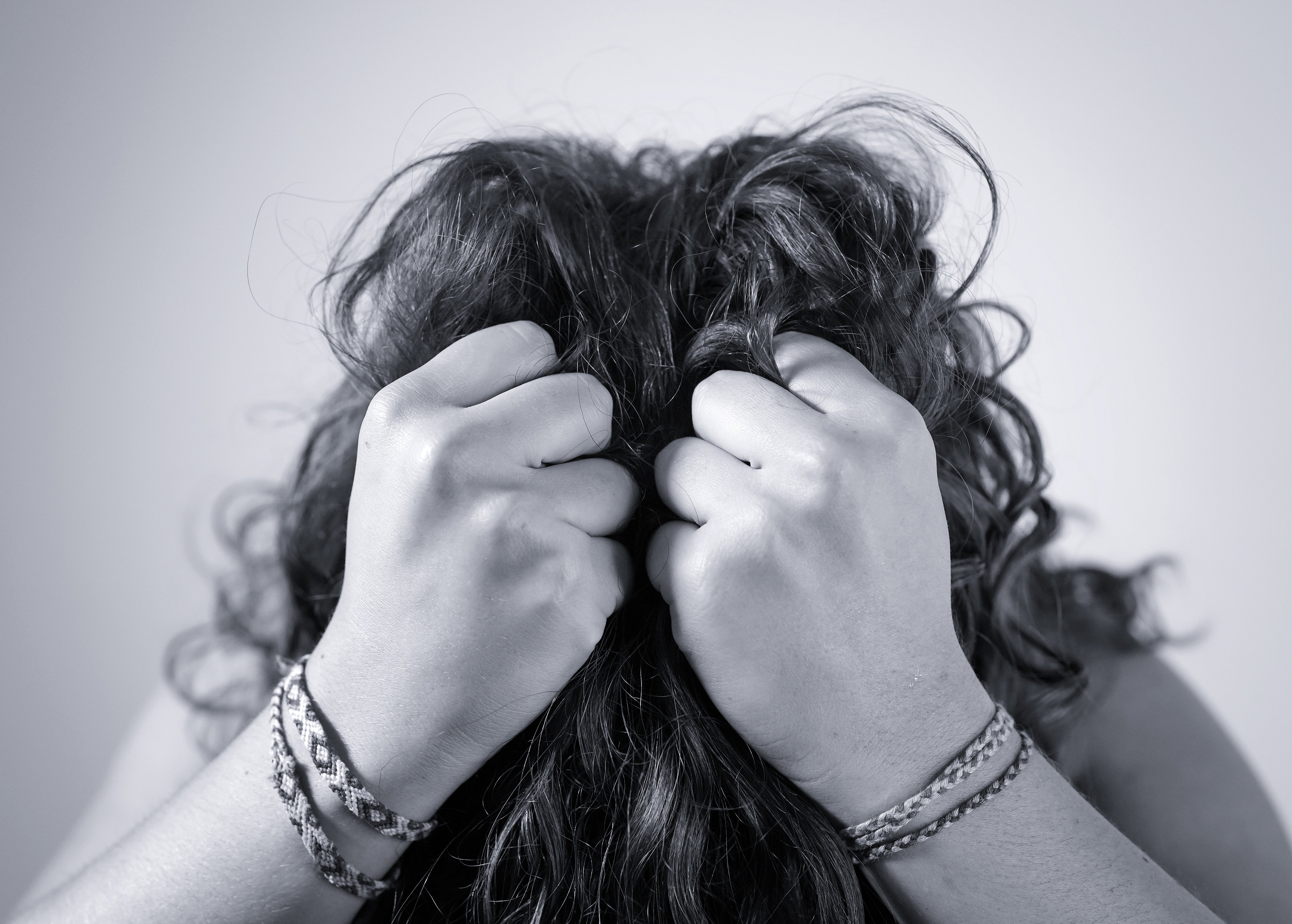
None of this is a flaw. Sensitivity is not only about what feels difficult. For some, it comes with an appreciation of detail, a deep response to music or a particular awareness of changes in their surroundings. These experiences will differ from person to person, in the same way as the things that overwhelm us.
The difficulty is that most of the world is designed for dials set somewhere in the middle. The festive season, in particular, seems to have been built with the volume turned all the way up and then left there for six weeks.
The Cost of Keeping Your Face Still
When the dial is high and the world is loud, something has to give. For many people, what gives is not visible in the moment. They stay at the gathering. They smile at the right times and join in with the conversation, even while the background noise turns every sentence into an effort to catch. From the outside, everything looks fine.
For some, particularly autistic people, this is part of what is called masking: changing or concealing responses so others will not notice the effort involved. Others may recognise the same pressure to appear comfortable, even if they would not use that word. Research into autistic masking suggests that the wish to protect ourselves and to belong can be powerful reasons for hiding differences, while prolonged camouflaging is associated with exhaustion and poorer mental wellbeing. Some people have done it for so long that they no longer register it as effort. It feels like manners, or being a good guest, or not making a fuss. Many learned early on that their reactions were too much for the people around them, that covering their ears or asking to leave would bring a sigh, a joke or a look. Hiding the reaction became the sensible thing to do.
The cost tends to arrive later. You get home and cannot face speaking to anyone. Someone asks a simple question and you snap. You spend the next day on the sofa with the curtains half closed, feeling flat and oddly guilty, as though you have failed at something without knowing what. The people closest to you may only ever see this part, which is how sensitive people sometimes end up with a reputation for being moody at Christmas, when the truth is that they have been working very hard for a very long time.
Perhaps you have noticed that you dread events you used to enjoy, and wondered what changed in you. Perhaps you have spent years believing you were bad at Christmas, when in fact you have been getting through it without anyone realising how much it took.
This is where shame tends to settle in. Over time, the story shifts from "that was a lot" to "there is something wrong with me for finding it a lot". The distance between those two sentences matters. The first describes an experience. The second turns the experience into a verdict about who you are, and verdicts like that have a way of making people hide even more, which only adds to the load.
You apologise for leaving early before anyone has said a word about it.
You're not broken. You're carrying strategies that once helped you survive, in rooms that were never built with you in mind.
Making Room for Your Own Needs
There is no switch that turns the season off, and the aim was never to become someone who no longer notices. What becomes possible instead is a different relationship with your own dial: understanding where it sits, recognising when the world is pushing it towards its limit, and giving yourself permission to respond before you reach the point of shutting down.
For some people this looks like wearing earplugs in the shopping centre and letting go of any embarrassment about them. For others it is shopping at quieter hours, keeping one evening a week deliberately empty, or deciding in advance how long they will stay at a party and which room they can slip into for a few minutes. These choices are not necessarily avoidance. They can be ways of recognising a limit and allowing enough room for the things that matter.
Those adjustments can be harder to make than they sound. Long habits of masking rarely fall away because someone says you are allowed to stop. Many people find they first need to understand why they learned to hide their reactions, and whose disappointment they were trying to avoid, before they can begin to choose differently.

This is often where therapy helps. A good counselling relationship offers a room where your reactions do not need explaining away or shrinking. Together, you can begin to map your own dial: what turns it up, what brings it down, which situations cost the most and which give something back. For neurodivergent adults, this can include making sense of a late diagnosis, or of a lifetime of being called oversensitive, and beginning to see those experiences in a kinder light. For others, it means looking at the old family rules that made sensitivity something to keep quiet about.
The work is rarely about learning to tolerate more noise. More often it is about discovering what your system needs, and building a life, and a Christmas, that takes those needs seriously. Many people find that once the shame eases, they have more energy for the parts of the season they do love, because less of it is being spent on pretending.
You tell your sister you'll come for lunch and leave before the games start, and she says "Of course".
The world may stay loud for a while yet, and there will be days when even the smallest things feel like too much. What can change is how you understand those moments, and how you treat yourself when they happen. Perhaps there can be less hiding, more permission, and a little more room this season for the way you experience the world.
Written by Kay Parkinson
MBACP (Accred), psychotherapist at Place to Talk Therapies.
A resource you may find helpful
The Sensory Capacity Check-In
References
Cook, J., Hull, L., Crane, L. and Mandy, W. (2021) 'Camouflaging in autism: a systematic review', Clinical Psychology Review, 89, article 102080. https://doi.org/10.1016/j.cpr.2021.102080
Dunn, W. (1997) 'The impact of sensory processing abilities on the daily lives of young children and their families: a conceptual model', Infants & Young Children, 9(4), pp. 23–35.
Greven, C.U. et al. (2019) 'Sensory processing sensitivity in the context of environmental sensitivity: a critical review and development of research agenda', Neuroscience & Biobehavioral Reviews, 98, pp. 287–305. https://doi.org/10.1016/j.neubiorev.2019.01.009
Jurek, L. et al. (2025) 'Sensory processing in individuals with attention-deficit/hyperactivity disorder compared with control populations: a systematic review and meta-analysis', Journal of the American Academy of Child & Adolescent Psychiatry, 64(10). https://doi.org/10.1016/j.jaac.2025.02.019
Klein, J., Krahn, R., Howe, S., Lewis, J., McMorris, C. and Macoun, S. (2025) 'A systematic review of social camouflaging in autistic adults and youth: implications and theory', Development and Psychopathology, 37(3), pp. 1320–1334. https://doi.org/10.1017/S0954579424001159